We often talk about diet, nutrition and supplements. But just as important is our digestion. Because no matter how perfect your diet is, it doesn’t matter if the body can’t break down, absorb and use the nutrients.
Over the course of a lifetime, up to 60 tons of food pass through our digestive system. It is one of the most advanced systems in the body. Digestion is not just a mechanical process. It is a finely tuned interplay between chemistry, microbiome, immune system and nervous system. And perhaps it is the role of the nervous system that is most underestimated.
The intestine – the body’s largest contact surface
Your gastrointestinal tract is an interface between you and the outside world. It is here that you decide what to let in and what to keep out.
In this environment live trillions of microorganisms, your microbiome. They produce vitamins, influence inflammation, train the immune system and communicate directly with the brain.
That’s why today we’re talking about the gut-brain axis, i.e. the connection between the gut and the brain.
There is also a separate nervous system in the gut, the enteric nervous system, which continuously regulates digestion and is in dialogue with the brain. When the balance in this system is disrupted, it can manifest itself far beyond the stomach in energy, immune system, skin and cognitive function.
The autonomic nervous system – a crucial but often forgotten key
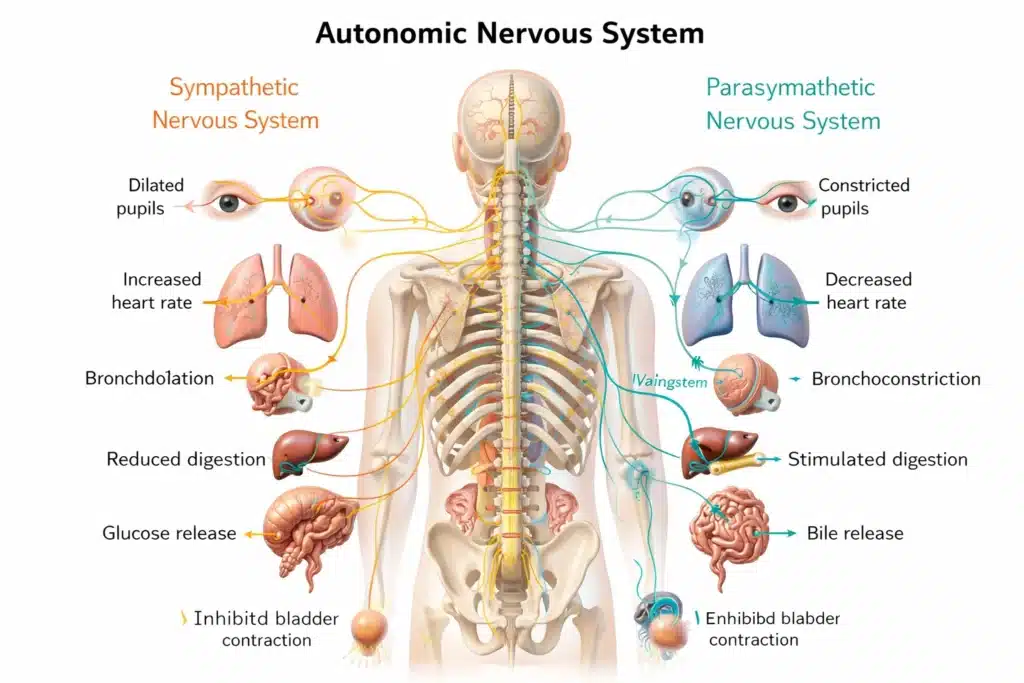
To fully understand digestion, we also need to zoom out. The autonomic nervous system, the part of the nervous system that controls the body’s unconscious functions, has a direct and decisive influence on how well we can digest our food.
There are two main modes:
- Sympathetic nervous system – fight and flight
- Parasympathetic nervous system – rest and digest
And it is precisely in the parasympathetic mode that digestion functions optimally.
When we are stressed or eating on the go, our bodies prioritize survival over digestion. Blood flow is diverted away from the gut, enzyme production decreases, and signaling in the gut changes. This means that we can effectively eat nutritious food but still not absorb the nutrients.
Digestion – a multi-step process
Digestion begins in the mouth, where enzymes in saliva begin the breakdown of carbohydrates. How well we chew affects the entire process.
In the stomach, the breakdown continues in an acidic environment where proteins are broken down, minerals are released and the conditions are created for the absorption of vitamin B12. At the same time, unwanted microorganisms are neutralized. Here, emptying is also regulated further to the small intestine in a finely tuned interaction between the nervous system and hormonal signals.
When food reaches the small intestine, a crucial shift occurs. Here, several organs are involved in the process. The pancreas releases enzymes that break down fat, protein, and carbohydrates. The liver produces bile, which is stored in the gallbladder and released when needed to enable fat absorption.
At the same time, a finely tuned hormonal system is activated where signals from the gut communicate with the brain and affect satiety, blood sugar regulation and energy balance. Digestion is therefore not only about absorbing nutrients but also about regulating how the body uses them.
The greatest nutrient absorption occurs in the small intestine, where up to 90% of nutrients are absorbed. Absorption is maximized through villi. Small finger-like projections that cover the inside of the small intestine’s mucosa and greatly increase the surface area for absorption. Although the small intestine is only a few meters long, the total absorption surface area corresponds to an average of about 30 square meters.
In the large intestine, the microbiome takes over a larger part of the work. Here, fibers are broken down and important metabolites are formed that affect both the immune system, metabolism and the brain.
Digestion is not just a breakdown process, it is a system that continuously interprets, regulates and adapts the body’s response to what we eat.
When digestion is not working optimally
It’s easy to think that digestive problems are just about the stomach and intestines. But in practice, it’s rarely an isolated problem. It’s an expression of an imbalance in a larger system.
Common signs can be bloating, gas or altered bowel function. But it also often manifests as fatigue, brain fog, anxiety, reduced stress tolerance or sleep problems.
What’s happening beneath the surface is that the body’s finely tuned systems are starting to lose sync.
When the breakdown of food does not function optimally, nutrient absorption is affected, which in turn can affect everything from energy production to neurotransmitters in the brain.
At the same time, an imbalance in the microbiome can alter the production of metabolites and signaling substances that affect both the immune system and the nervous system. The intestinal barrier function can also be affected, which increases the burden on the immune system and can drive low-grade inflammation.
That’s why symptoms often span multiple systems at once. It’s not just about what’s happening in the gut, but how the entire body is affected.
What makes a real difference?
When you strip away all the advice, trends and quick fixes, we often end up with something much more basic.
Diet plays a central role. Fiber, plant-based variety and fermented foods act as nutrients for the microbiome and contribute to a more resilient and balanced intestinal environment. Here, short-chain fatty acids and other signaling molecules are formed that affect inflammation, metabolism and the immune system far beyond the intestine.
But for the body to be able to use the nutrients, the right physiological conditions are required.
Digestion is heavily dependent on the autonomic nervous system and functions optimally in a parasympathetic mode. If the body is in a constant state of stress, blood flow to the intestines decreases, enzyme production decreases, and the ability to break down and absorb nutrients deteriorates.
This means that how you eat is at least as important for digestion as what you eat.
- sit down in peace and quiet
- chew food thoroughly
- avoid eating under stress or distraction
- give your body breaks between meals
Movement and hydration are also key. Movement stimulates intestinal motility (rhythmic movements) and positively affects the microbiome. Water is needed at every stage, from breakdown to transport and elimination. When these parts work together, the conditions are created for the body to actually receive and use the nutrition we provide.
References
-
Fonseca (2026).Nutrition, Digestive System, and Clinical Gastroenterology. Nutrients doi: 10.3390/nu18050733
-
Rupa Health: The Digestive System Explained: Improve Your Gut Health. https://www.rupahealth.com/post/the-digestive-system-explained-improve-your-gut-health
-
Rupa Health: Navigating Nutrient Absorption: Functional Medicine for Optimal Digestion https://www.rupahealth.com/post/navigating-nutrient-absorption-functional-medicine-for-optimal-digestion