Fat has long had an undeserved bad reputation. For decades we have been told that fat makes us sick, overweight and tired. Today we know that this is an oversimplified picture. Fat is not only energy, it is one of the body’s most basic building blocks and is absolutely crucial to how we function, from the cellular level to the brain and hormonal system.
Every cell in the body is surrounded by a cell membrane that is largely made up of fat. These membranes are not static protective envelopes, but dynamic and flexible structures that control how the cell communicates, receives signals and transports nutrients and waste products. The quality of the fat affects how flexible these membranes are – and thus how efficiently the cells can carry out their tasks. When the fat balance is favorable, the cells’ signaling functions better, while an imbalance can make the systems slower and more vulnerable.
Different types of fat
However, fat is not a uniform category. Different fatty acids have different chemical properties and fulfill different biological functions in the body. Fat is not only used as energy, but also functions as a building material, signaling molecule, hormonal raw material and carrier of fat-soluble vitamins. How fat affects the body therefore depends on the type of fat, in what quantity and in what context it is consumed.
- Saturated fat is used by the body as a stable building block and energy source. It contributes to structural stability in cells and tissues and is involved in several hormonal and metabolic processes. In the diet, saturated fat occurs naturally in animal foods such as meat, dairy products and eggs, as well as in some plant fats such as coconut oil.
- Monounsaturated fat is involved in both energy metabolism and the regulation of lipid metabolism. It is used as fuel and is part of the body’s normal fat metabolism. In the diet, monounsaturated fat is mainly found in olive oil, avocados, certain nuts and seeds, and animal fat.
- Polyunsaturated fats are biologically active and are used as raw materials for signaling molecules that regulate inflammation, immune function, and nervous system function. These include omega-3 and omega-6, both of which are essential for life. In the diet, omega-3 is found primarily in fatty fish, roe, and certain marine foods, while omega-6 is found in seeds, nuts, and vegetable oils, as well as in many processed foods.
All types of fat are necessary. The body is adapted to a variety of fatty acids that together support energy production, hormonal regulation, nervous system function and recovery. It is the interaction between fats, not individual categories, that determines how well the systems function.

Important functions in the body
The brain is a clear example of the importance of fat. A large part of the brain’s dry weight consists of fat (60%), and nerve cell communication is highly dependent on the correct fat composition in the membranes. Fat affects how quickly and accurately signals are transmitted between nerve cells, which in turn affects cognition, memory, focus and stress tolerance. This is why fat quality is not only about physical health, but also about mental acuity and emotional balance.
The hormonal system is also intimately linked to fat. Many hormones are formed from fat or require fat to be transported and function in the body. Fat is also necessary for the body to adapt to stress, regulate inflammation and maintain hormonal stability over time. An excessively low-fat or unbalanced fat intake can therefore affect both energy levels, mood and hormonal function.
Fat also plays a crucial role in the absorption of the fat-soluble vitamins A, D, E and K. These vitamins are central to the immune system, bones, blood clotting, gene regulation and protection against oxidative stress. Without enough fat in the diet, the body simply cannot absorb these nutrients, no matter how nutritious the diet is.
At the cellular level, fat is also important for mitochondria, the cells’ energy producers. Mitochondrial membranes depend on the right fat composition for energy production to function effectively. Fat quality therefore affects not only how much energy we get, but also how well the body can convert nutrients into usable energy.

Fat in a natural context
Natural fats from whole foods interact with the body in a completely different way than industrially processed fats. Fats consumed in their natural context contribute to stable energy, satiety, and functioning biological systems, while highly processed fats easily upset the balance.
When fat intake is well thought out and of good quality, fat does not become a problem but a prerequisite for health, recovery and long-term function. Fat is not the enemy. Fat is one of the body’s most important allies.
Fatty acid balance
Many of the fat sources we use today are artificially produced, even though they are presented as coming from regular agricultural products. This can cause the body to be burdened by an imbalance in fatty acids, which can create inflammatory processes.
How can I know which fats are more or less healthy?
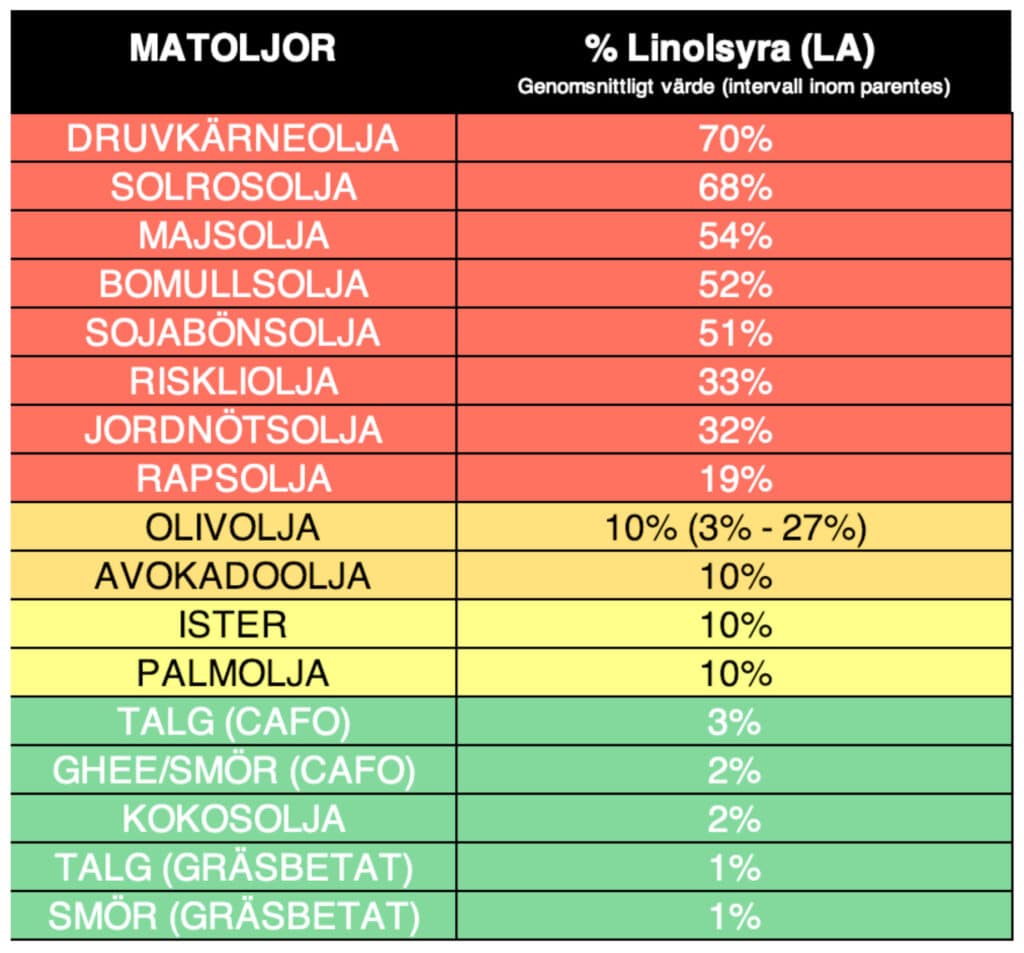
Linoleic acid is often cited as the fatty acid that “tips the balance.” Here is a table showing the linoleic acid content in some common types of oil.